News


How a social media migration revealed fundamental differences in service delivery—and what it means for the future of international commerce
Published: February 2026 | Reading time: 8 minutes
Overview
In January 2025, over 700,000 American users migrated to the Chinese social media platform Xiaohongshu (known internationally as RedNote) in response to a potential TikTok ban in the United States. What began as a digital protest evolved into an unprecedented cross-cultural exchange with measurable economic consequences.
One year later, international patient visits to Chinese hospitals reached 1.28 million—a 73.6% increase from 2022 levels, according to China's National Health Commission. This surge represents more than a trend in medical tourism; it signals a fundamental shift in how consumers discover, evaluate, and engage with service providers across borders.
This article examines the intersection of social media, service model differentiation, and cross-border commerce through the lens of China's medical tourism boom.
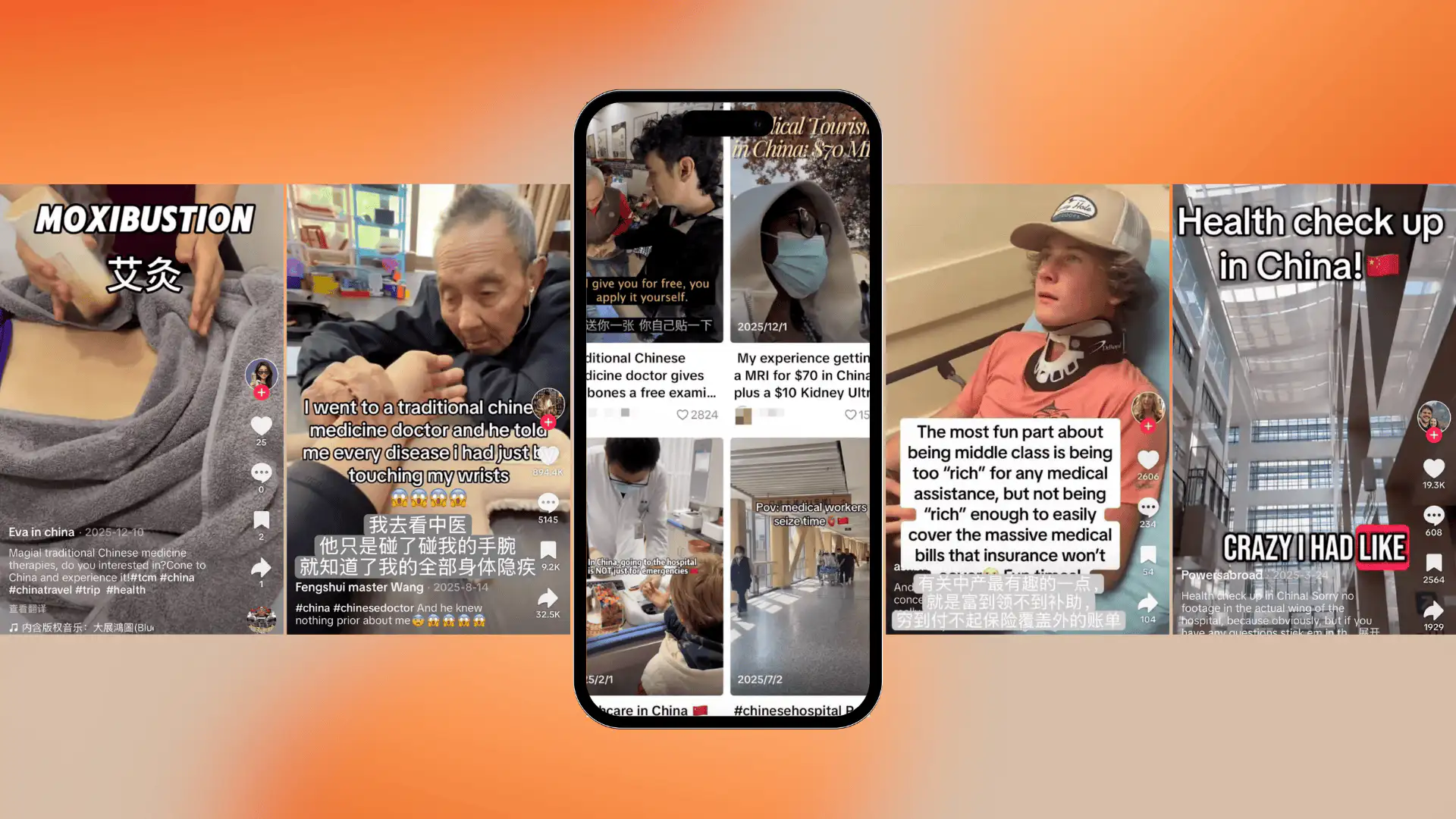
The TikTok Refugee Phenomenon: A Natural Experiment in Cross-Cultural Comparison
The Initial Migration
In January 2025, as TikTok faced a potential ban in the United States, over 700,000 American users migrated to Xiaohongshu, a Chinese social media platform combining elements of Instagram and Pinterest with e-commerce functionality. Users dubbed themselves "TikTok refugees," and the hashtag #TikTokRefugee accumulated over 80 million views.
Chinese users responded by creating English-language tutorials, welcoming messages, and cultural exchange content. Language learning platform Duolingo reported a 216% increase in Americans studying Mandarin compared to the same period in the previous year, indicating sustained engagement beyond initial curiosity.
From Digital Curiosity to Market Discovery
The migration created an unusual circumstance: direct, peer-to-peer communication between users of two fundamentally different social and economic systems, without institutional or media intermediation.
Users began what can be characterized as an "account reconciliation" process—comparing everyday experiences, including:
Cost of living
Service accessibility
Healthcare expenses
Consumer product pricing
Quality-of-life metrics
This organic comparison revealed significant disparities in service delivery models, particularly in healthcare.
The Data: Measuring Impact One Year Later
Healthcare Cost Disparities
Price comparisons that emerged from user-generated content revealed substantial differences:
Medical Service | China (USD) | United States (USD, without insurance) |
|---|---|---|
Routine heart examination | $75 | $10,000 - $20,000 |
Standard X-ray | $19 | $200 - $500 |
Emergency room visit with diagnostics and treatment | $144 | $5,000 - $15,000 |
These figures, widely shared on social media platforms, generated significant attention and skepticism, prompting users to verify claims through direct experience.
International Patient Volume Growth
Following the TikTok refugee migration, international patient visits to Chinese healthcare facilities demonstrated measurable growth:
2025 International Patient Data:
Shenzhen: Over 770,000 international patients served (640,000 from Hong Kong and Macau; remainder from United States, Canada, Japan, and other countries)
Shanghai: 270,000 international patients across 13 designated international hospitals (15% year-over-year increase)
National Total: 1.28 million international patient visits (73.6% increase from 2022)
TikTok's #MedicalTourism hashtag demonstrated exponential growth in China-related content throughout 2025.
Historical Context: Cross-Border Medical Tourism
Cross-border medical tourism is not a novel phenomenon. Americans have sought medical and dental care in Mexico for several decades.
The Los Algodones Case Study
Los Algodones, Mexico—colloquially termed "Molar City"—serves as an established medical tourism hub:
Key Statistics:
Population: Approximately 6,000 residents
Dental professionals: Over 600 dentists
Daily visitor volume: Approximately 13,000 tourists during winter months
Annual US visitors to Mexico for medical/dental care: Approximately 1 million
Cost Comparison:
A three-unit dental bridge costs approximately $5,000 in California versus $1,300 in Los Algodones—a 74% cost reduction.
Distinguishing Factors: China vs. Traditional Medical Tourism Destinations
While cost arbitrage drives both Mexican and Chinese medical tourism, three factors differentiate China's recent growth:
1. Social Media Visibility
Traditional medical tourism relies on agency intermediaries and limited peer reviews. The TikTok refugee migration created direct communication channels between consumers, enabling real-time, unfiltered information exchange.
2. System-Level Differentiation
Mexican dental tourism represents cost arbitrage within comparable service delivery models. China's appeal stems from fundamentally different organizational principles in healthcare delivery.
3. Unintentional Soft Power Transmission
Neither Mexican nor Chinese governments actively marketed medical tourism capabilities to American consumers. However, social media algorithms amplified user-generated content, creating organic visibility at unprecedented scale.
Understanding China's Healthcare System Model
China's healthcare system operates on organizational principles that differ substantially from Western models:
Structural Characteristics
High-Density, High-Throughput Operations
Chinese hospitals process approximately 10 times the patient volume per physician compared to typical Western healthcare facilities. This design prioritizes system efficiency and patient throughput over extended individual consultations.
Minimal Appointment Gatekeeping
Walk-in patient access is standard rather than exceptional. The system accommodates high volumes without extensive pre-scheduling requirements, reducing wait times for initial consultations.
Vertical Integration
Diagnosis, diagnostic testing, treatment, and pharmacy services typically operate within single facilities, minimizing inter-facility referrals and coordination delays.
Rapid Results Turnaround
Diagnostic test results are frequently available within hours rather than days or weeks, enabling same-day diagnosis and treatment initiation.
Cultural and Economic Context
These organizational characteristics reflect several factors:
Population density: High urban concentration necessitates high-throughput systems
Labor market structure: Large healthcare workforce enables high-density staffing
Regulatory framework: Centralized healthcare administration facilitates vertical integration
Patient expectations: Cultural acceptance of higher patient volumes and shorter consultation times
The Service Model Export Thesis
Infrastructure vs. Service Models
Previous waves of international interest in Chinese development focused on infrastructure and technology:
Previous Focus Areas:
High-speed rail networks
Mobile payment adoption (Alipay, WeChat Pay)
5G telecommunications infrastructure
Automated retail and hospitality services
These represent impressive engineering and convenient technology—capabilities that are ultimately replicable by other nations with sufficient capital investment.
Current Focus: Service Models
Service models differ from infrastructure and technology in a critical way: they are shaped by culture, regulatory frameworks, labor markets, and social organization. These characteristics make service models significantly more difficult to replicate across different contexts.
Why Service Model Differentiation Matters
1. Reveals Organizational Logic
Infrastructure demonstrates construction capabilities. Service model efficiency demonstrates how societies organize human systems—staffing density, administrative structures, workflow optimization, and cultural expectations.
2. Creates Sustainable Engagement
Infrastructure impresses observers temporarily. Service experiences that address real consumer needs create repeat engagement and generate word-of-mouth advocacy.
3. Drives Cultural Reframing
Western engagement with Chinese services historically focused on cultural curiosity (traditional Chinese medicine, acupuncture). Current engagement is functionally motivated—Chinese services deliver desired outcomes at lower costs with greater efficiency.
This represents a fundamental shift from cultural tourism to functional preference.
Implications for Business Strategy
For Marketing and Communications
Finding: Peer-to-peer validation surpasses institutional messaging in credibility
Traditional marketing campaigns emphasizing healthcare quality and affordability were ineffective at generating international interest in Chinese healthcare facilities. However, thousands of user-generated social media posts documenting personal experiences accomplished what institutional campaigns could not.
Strategic Implication:
Organizations should facilitate authentic peer-to-peer customer experiences on social platforms rather than relying exclusively on controlled brand messaging. User-generated content, when genuine, carries significantly higher credibility than institutional communications.
For International Market Development
Finding: Social media makes service models transparent and comparable in real-time
The TikTok refugee migration was unplanned by any government or corporation. Nevertheless, it generated immediate market intelligence about consumer preferences and revealed opportunities for cross-border service delivery.
Strategic Implication:
Monitor user-generated content and platform migration patterns as leading indicators of consumer preference shifts. Cross-border platform user behavior may reveal market opportunities before traditional market research methodologies.
For Competitive Strategy
Finding: Service model differentiation creates defensible competitive advantages
Infrastructure and technology can be replicated through capital investment and knowledge transfer. Organizational models shaped by cultural context, regulatory environments, and labor market structures represent more durable competitive advantages.
Strategic Implication:
When evaluating international competition, analyze not only what competitors offer but how their entire service delivery systems operate. System-level differences may represent greater competitive threats (or opportunities) than individual product or service features.
Future Outlook: The Transparency Imperative
Short-Term Projections (2026-2027)
Expect increased user-generated comparison content across additional service categories:
Education and tutoring services
Professional consulting
Retail experiences
Real estate services
Personal care and wellness
Social media algorithms favor "I went to Country X and experienced Y" content formats, incentivizing continued cross-cultural service comparisons.
Medium-Term Projections (2027-2030)
Established service providers in high-cost markets will experiment with alternative delivery models to compete with emerging options. Some Western hospitals are already developing international patient clinics featuring expedited access and transparent pricing.
Traditional service providers may adopt selected features from alternative models while maintaining core operational characteristics suited to their regulatory and cultural contexts.
Long-Term Implications
The fundamental question is not which countries "win" in specific service categories. Rather, it is how organizations and policymakers respond when consumers can easily observe, validate, and access alternative service models through peer networks.
Key Consideration:
Organizations that adapt successfully will not necessarily operate the "best" systems according to any universal criteria. They will be organizations most capable of learning from systems that operate differently and incorporating valuable lessons while remaining authentic to their cultural and regulatory contexts.
Conclusion
What commenced as 700,000 Americans joining a Chinese social media platform to protest a potential application ban evolved into a catalyst for 1.28 million international patient visits to Chinese healthcare facilities over the subsequent year.
This case study demonstrates several principles relevant to the evolving landscape of international commerce:
1. Transparency is Accelerating
Social media platforms enable consumers to observe, compare, and validate service delivery models across borders with unprecedented ease and speed.
2. Peer Validation Trumps Institutional Messaging
User-generated content carries higher credibility than institutional marketing communications when consumers evaluate unfamiliar service providers.
3. Service Model Differentiation Creates Competitive Advantage
System-level organizational differences represent more defensible competitive positions than price competition or individual feature sets.
4. Cross-Border Comparison is Normalizing
Platform migrations and user-generated content are normalizing cross-cultural service comparisons, making service quality and value increasingly visible across geographic boundaries.
5. Adaptability is Essential
Organizations navigating international markets must develop capacity to learn from alternative service delivery models while remaining authentic to their operational contexts.
The "TikTok refugees" of January 2025 discovered something more valuable than an alternative social media platform—they discovered transparency into how services can be organized differently. That discovery is reshaping consumer behavior and competitive dynamics across multiple service industries.
About BWB Weekly
This analysis is published as part of BWB Weekly, an independent newsletter examining Chinese social media trends, B2B marketing strategies, and cross-cultural marketing innovations underreported in mainstream Western media.
Mission:
BWB Weekly bridges Chinese and Western marketing ecosystems through culturally-aware curation and anti-formulaic analysis, delivering marketing insights that matter while cutting through information noise.
Subscribe for Weekly Analysis
Published every Monday.
📧 Subscribe to Newsletter | 💼 Connect on LinkedIn | 🐦 Follow on Twitter/X
Sources and References
Voice of America: US 'TikTok Refugees' migrate to another Chinese app as ban looms
The Conversation: TikTok users migrate to RedNote in an unexpected success for Chinese soft power
Boston.com: TikTok refugees are joining Xiaohongshu. Here's what to know about the app
China Daily: 'TikTok refugees' migrate to Xiaohongshu amid ban fears
Away Clinic: Data: The State of Mexican Dental Tourism in 2024
Medical Tourism Co: Dental Work in Mexico - 2026 Cost Guide, Best Cities & Safety Tips
Recommended Reading
Related Articles:
"Cross-Cultural Marketing in the Age of Social Media Transparency"
"Service Model Innovation in Emerging Markets"
"The Evolution of Medical Tourism: From Cost Arbitrage to System Preference"
Further Research:
National Health Commission of China: Annual Report on International Medical Services
Journal of Medical Tourism Research: Cross-Border Healthcare Trends
Social Media Analytics: Platform Migration Patterns and Consumer Behavior
© 2026 BWB Weekly. All rights reserved.
This article may be shared with attribution. For reprints or commercial use, please contact the author.
Ready to win Chinese customers?
Brands Without Borders helps businesses abroad reach Chinese travelers and consumers on Xiaohongshu and WeChat, from hotels and destinations to restaurants, retail and luxury brands. We handle account setup and verification, creative, media buying and the WeCom handoff that turns a post into a booking or a sale.