Insight

How WeChat advertising works for overseas brands: five ad types, contract vs bidding, Tencent’s minimum budgets and the approval rules.
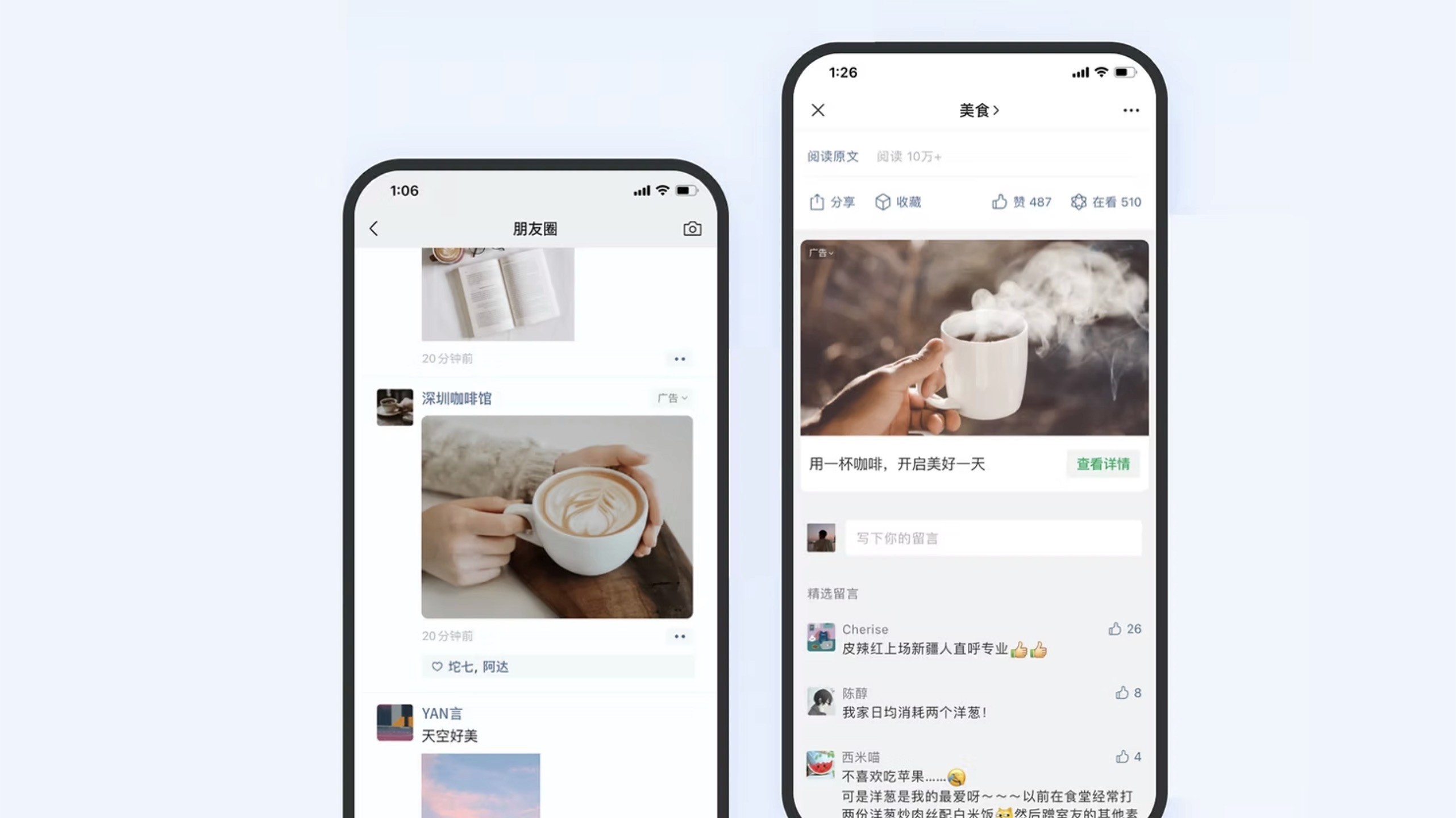
WeChat advertising is sold through Tencent Ads and covers five main placements: Moments, Channels (Video Accounts), Official Account articles, Mini Programs and Search. Most placements can be bought two ways, as a reserved contract at a fixed rate-card price or through a real-time auction. Overseas brands can run them through a verified overseas Official Account or an authorized Tencent service provider. This guide covers what each ad type does, what it costs to start, and how a hotel or brand outside China gets approved.
Why WeChat advertising still matters in 2026
WeChat is still the default app in China. Tencent reported 1,439 million combined monthly active users for Weixin and WeChat as of June 30, 2026, up 2% year on year (Tencent Q2 2026 results).
The ad business behind it is growing faster than the user base. Tencent’s marketing services revenue reached RMB 43.6 billion in the second quarter of 2026, up 22% year on year. The company credited three things: a better AI ad recommendation model, upgrades to its automated campaign tool AIM+, and “closed-loop” marketing inside Weixin, meaning the ad, the content and the purchase can all happen without leaving the app. Time spent on Video Accounts (Channels) grew more than 20% year on year in the same quarter.
For an overseas hotel or brand, that closed loop is the real reason to care. A WeChat ad does not have to send people to a website they cannot load or read. It can send them to your Official Account, a Mini Program or a chat, where a Chinese-speaking team can answer questions and take the inquiry.
The 5 main types of WeChat ads
Ad type | Where it appears | Best for |
|---|---|---|
Moments ads | In the feed of posts from friends | Awareness, launches, growing followers |
Channels (Video Accounts) ads | In the short-video feed and around livestreams | Video storytelling, live selling |
Official Account ads | Inside or below articles from other publishers | Reaching readers of relevant content |
Mini Program ads | Banners, pop-ups and interstitials inside Mini Programs | App installs, promotions |
Search ads | In WeChat search (Sou Yi Sou) results | Capturing people who are already searching |
Moments ads
Moments ads sit in the same feed where users see posts from friends, which makes them WeChat’s most visible placement and, as Sinorbis notes, a comparatively expensive one. Tencent Ads lists image-and-text, video and card formats, with goals that include promoting an event, an Official Account, an app, a WeChat voucher or a local store (Tencent Ads Moments FAQ). Some newer formats are auction-only: Tencent’s own product notes say the Moments “showcase” ad supports bidding but not contracts (Tencent Ads product update).
We cover formats and creative in more depth in our WeChat Moments ads guide.
Channels (Video Accounts) ads
Channels is WeChat’s vertical short-video feed. Ads run as in-feed videos and can also drive traffic to livestreams (AppInChina). Given the 20%-plus growth in time spent, this is the placement to watch in 2026, and Tencent says custom video uploads for Channels can be bought by contract or by auction (Tencent Ads product update). For hotels and destinations, short video usually shows the property better than a single image.
Official Account ads
Official Accounts are WeChat’s publishing channels, closer to an email newsletter than a social profile. Official Account ads appear as banners inside or below other publishers’ articles, and as pre-roll on longer videos (Sinorbis). These are different from paid posts on an influencer’s account, which you arrange with the account owner rather than buy through Tencent Ads.
Mini Program ads
Mini Programs are lightweight apps that run inside WeChat. Ads inside them come as banners, rewarded video, pop-ups, interstitials and grid ads (Sinorbis). They interrupt a task rather than sit in a feed, so they tend to suit app installs and promotions better than luxury storytelling.
Search ads
WeChat search (搜一搜, Sou Yi Sou) shows ads next to organic results. The premium version is Brand Zone, which is bought as a contract by keyword, so each keyword you buy gets its own creative (Tencent Ads product update). For a known hotel brand, Brand Zone on your own name is a defensive buy: it controls what people see when they look you up after hearing about you somewhere else.
Contract vs bidding: two ways to buy WeChat ads
This is the choice most guides skip, and it shapes your budget more than the ad format does.
Contract (合约) ads, which Tencent calls scheduled purchase, are reserved in advance. You pay the CPM on Tencent’s rate card, delivery is guaranteed for the dates you book, and you know the total cost before the campaign starts. For Moments, a scheduled campaign needs a total budget of at least RMB 50,000.
Bidding (竞价) ads run as a real-time auction. You set a daily budget and a bid, and the price moves with competition for the same audience. For Moments, the CPM starts at RMB 30 and the daily budget starts at RMB 1,000 (Tencent Ads Moments FAQ).
Contract (scheduled) | Bidding (auction) | |
|---|---|---|
Price | Fixed rate-card CPM | Set by auction, from RMB 30 CPM on Moments |
Minimum on Moments | RMB 50,000 total per campaign | RMB 1,000 per day |
Delivery | Guaranteed for booked dates | Depends on bid and competition |
Flexibility | Low; creative changes are limited once live | Budgets and targeting can be adjusted after approval |
Best for | Launches, Golden Week, Chinese New Year | Testing, always-on campaigns, lead generation |
Two points to keep in mind. First, Tencent’s figures are floors, not quotes. Real costs depend on audience, city, season and creative. An older Moments rate card published by WalktheChat priced Beijing and Shanghai at RMB 150 CPM for image ads against RMB 50 for smaller cities, so treat city choice as a cost lever. Second, foreign advertisers can face a higher entry point: Sinorbis reported in 2024 that Tencent required a minimum of US$10,000, before any agency fees.
For most overseas brands, the sensible order is to start with bidding, learn which audiences and creatives work, then reserve contract inventory for the few dates when you cannot afford to miss delivery.
Can overseas brands advertise on WeChat?
Yes, with conditions. There are two routes (AppInChina):
Overseas entity: verify an overseas Official Account, then apply to Tencent for advertiser admission. Overseas companies can only open a Service Account, not a Subscription Account (The Egg). Our guide to registering a WeChat Official Account overseas walks through it.
Through a partner: work with a China-registered company or an authorized agency. Tencent keeps a directory of service providers for Hong Kong, Macau, Taiwan and overseas advertisers (Tencent Ads).
Expect to provide company registration documents, any licenses your industry requires, and trademark registration or brand authorization letters where relevant. If your ads link to your own website rather than a WeChat page, Tencent asks for proof of an ICP filing for that domain (Tencent Ads qualifications). Most overseas websites do not have one, which is another reason to send traffic to an Official Account or Mini Program instead.
Industry matters too. Tencent’s rules for overseas advertisers allow 25 categories, including tourism, e-commerce, cosmetics, food, jewelry and watches, sports and outdoor, automotive and apparel. Healthcare, real estate, legal services, dating, lottery and most education and financial services are not supported for overseas advertisers (Tencent Ads overseas rules). Advertisers registered as individuals are not accepted. See our list of industries banned from WeChat advertising for the domestic picture.
Targeting: who you can and cannot reach
Moments targeting covers region, gender, age, device, education, interests, location and retargeting (Tencent Ads Moments FAQ). On top of that, AIM+ automates bidding and audience expansion once a campaign has data.
The limit hotels need to know: WeChat ads reach people in mainland China who are planning a trip, not Chinese travelers who are already at your destination. WalktheChat reported that WeChat’s product for targeting Chinese tourists overseas was paused in 2021. In practice, that means building audiences around trip planning: high-income cities with direct flights to your destination, travel and luxury interests, and retargeting people who already follow or read your Official Account.
Where the click should go
A WeChat ad is only as good as the page it opens. The common destinations are an Official Account article or follow page, a Mini Program, a WeChat store page, or an external landing page (AppInChina).
For hotels and travel brands, an English booking engine is usually the weakest option. It may load slowly in China, it often lacks WeChat Pay, and it does not let the guest ask a question. A Chinese-language Official Account article with room types, rates guidance and a clear way to message the team keeps the guest inside WeChat and gives you a follower you can reach again before the next holiday.
A simple starting plan for hotels and travel brands
Fix the base first. Verify an overseas Service Account and publish a handful of Chinese-language articles that answer the questions guests actually ask: how to get there, payment options, family facilities, Chinese-speaking staff.
Test with bidding. Run Moments or Channels ads in two or three high-income cities with direct air links to your destination. Keep two or three creatives live so the system can compare them.
Measure what matters. Track new followers, messages and inquiries, not just clicks. A cheap click that never asks a question is not a good click.
Reserve for peaks. Once you know which audience and creative convert, book contract inventory early for Golden Week and Chinese New Year, when competition for the same users is highest.
Keep the loop warm. Retarget followers and readers between campaigns. They are your cheapest future bookings.
FAQ
Can I advertise on WeChat without a Chinese company?
Yes. An overseas company can verify an overseas Official Account and apply to Tencent for advertiser admission, or work through an authorized Tencent service provider. What you cannot do is advertise as an individual: Tencent does not accept overseas advertisers registered as individuals. You will still need brand documents and, for regulated industries, the relevant licenses.
How long does WeChat ad approval take?
Tencent says Moments ads are reviewed within two working days. Changing the creative after submission sends the ad back for another review, while budget, timing and audience changes made after approval do not. For overseas brands, advertiser admission and Official Account verification come first and are separate steps, so finish them well before any campaign date you need to hit.
Can WeChat ads target Chinese tourists who are already abroad?
Not reliably. WalktheChat reported that WeChat’s product for reaching Chinese travelers in overseas destinations was paused in 2021 after data protection changes. Hotels get better results by reaching travelers in mainland China while they plan, using city, interest and retargeting options, then staying in touch through an Official Account before and after the stay.
Should a hotel start with WeChat ads or Xiaohongshu ads?
It depends on what you already have. Xiaohongshu is built for discovery: people search it for destinations, hotels and reviews. WeChat is built for conversation and repeat contact. If your Official Account is empty, WeChat ads have nowhere useful to send people, so build that base first, or start with Xiaohongshu while you do.
What this means for your hotel or brand
WeChat advertising is not a single button. It is a set of placements, two buying models and an approval process that rewards brands with a working Official Account and Chinese-language content behind the ad. For most hotels and travel brands, the winning setup is modest: bidding campaigns to learn, contract buys for the few peak dates that matter, and every click landing somewhere a Chinese guest can ask a question. If you want to know where your brand stands today, ask us for a free visibility audit and we will show you what Chinese travelers currently find when they look for you.
Ready to win Chinese customers?
Brands Without Borders helps businesses abroad reach Chinese travelers and consumers on Xiaohongshu and WeChat, from hotels and destinations to restaurants, retail and luxury brands. We handle account setup and verification, creative, media buying and the WeCom handoff that turns a post into a booking or a sale.